

PowerOn Midwest Tomorrow's reliability starts today.
PowerOn Midwest is a series of new electric transmission projects anchored by a 765 kV backbone transmission line being developed by Great River Energy, ITC Midwest, Otter Tail Power Company and Xcel Energy. The projects will connect eastern South Dakota, southern Minnesota and the broader region, enhancing grid reliability in the Upper Midwest to meet growing and evolving energy needs in the coming decades.

 Trending topics What people are asking
 Download factsheets Find key information fast
 Local benefits How the project supports communities
Project area
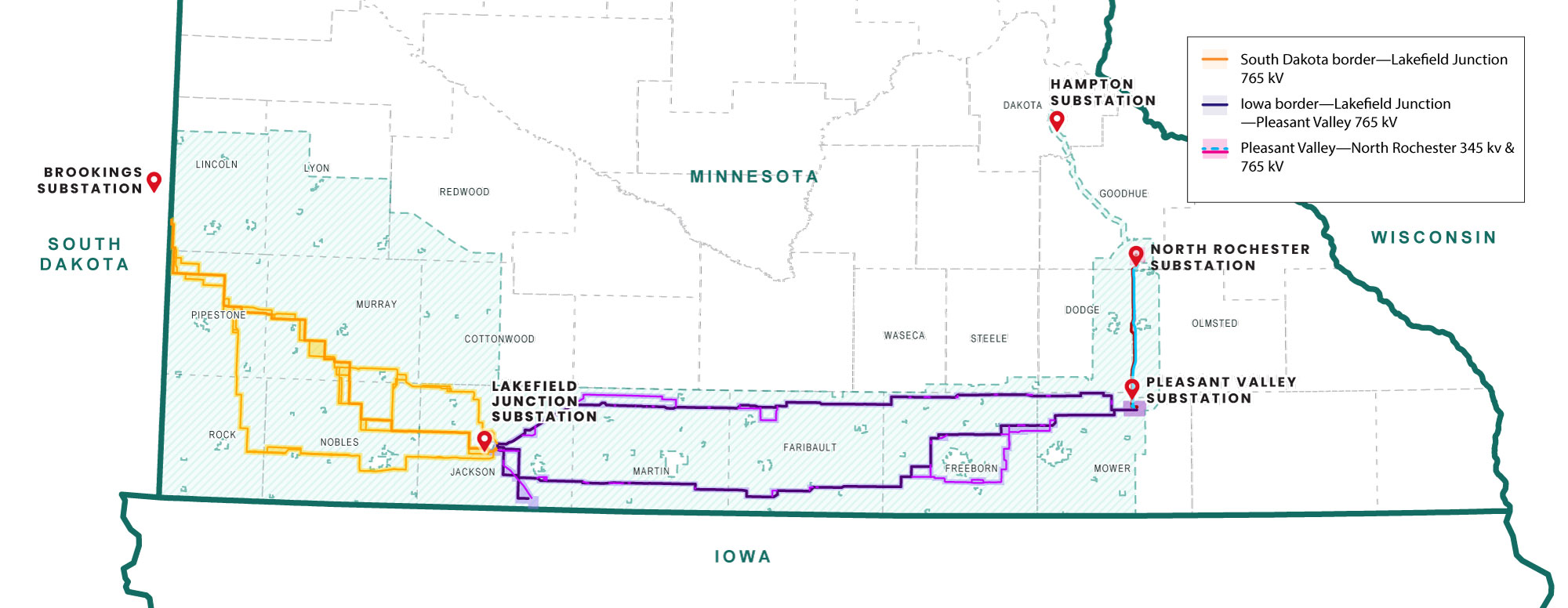
This map shows the four segments that make up the PowerOn Midwest project area in Minnesota. PowerOn Midwest will offer multiple opportunities for stakeholders, Tribal entities, landowners, and the public to provide input into the route development process.
Segments
-
South Dakota border-Lakefield Junction (765 kV)
MISO LRTP #22 - Minnesota portion
ITC Midwest, Xcel Energy -
Iowa border-Lakefield Junction-Pleasant Valley (765 kV)
MISO LRTP #23 and #24
Great River Energy, ITC Midwest
-
Pleasant Valley-North Rochester (345 kV & 765 kV)
MISO LRTP #24
Great River Energy, Xcel Energy -
North Rochester-Hampton 2nd Circuit (345 kV)
MISO LRTP #25
Xcel Energy, Dairyland Power Cooperative, Southern Minnesota Municipal Power Agency, the City of Rochester
Click or tap on the icons below to learn more about that segment.

Regional energy use
PowerOn Midwest will support communities in southern Minnesota by better connecting the local lines serving local load and generation to the resources of the wider region. Each substation along the PowerOn Midwest route is a key grid connection point where electricity can flow onto or off the transmission system, helping move power between generators and local consumers.
Power will flow in both directions through these lines and substations throughout the year depending on weather conditions. Take a look at the animation: when it is windy in the west and calm in the east, excess power generated by wind turbines in the west will flow on the lines and serve the load to the east. A few hours later when the weather pattern shifts east, the flows reverse and excess power from wind turbines in the east flow to serve customers in the west. This also applies to when customer’s cooling or heating needs increase electricity usage, and when cloud cover impacts solar panel output.
Key benefits
-
Reliable electricity
Delivers on our commitment to customers that electricity is delivered where and when it's needed—regardless of the weather, electric generation source, or demand.
-
Future-ready grid
Addresses rising electricity demand, which is projected to grow significantly over the next two decades.
-
Customer and economic benefits
Enables more cost-effective generation while improving reliability, opening doors for future economic growth across the region.
-
Access to new electric generation
Supports a range of energy sources added to the grid, providing a balanced and reliable power supply for the future.



Preliminary schedule
Developing and building major new transmission lines is a multi-year process that begins with significant planning, which identifies general project areas, includes comprehensive outreach to local landowners and officials to explore potential route options, and involves a robust regulatory review by state officials. If approved, construction would begin in 2030, with segments expected to be in-service between 2032 and 2034.
As our schedule evolves, we will provide updated information.
-
2025
- Project planning
- Initial stakeholder and public engagement
-
2026-2027
- File PowerOn Midwest Certificate of Need application with Minnesota Public Utilities Commission (MPUC)
- Certificate of Need MPUC review process
- Route development
- File Route Permit applications with MPUC
-
2027-2029
- Route Permit MPUC review processes
- Engineering design
- Environmental surveys and permitting
- Easement acquisition
-
2030-2034
- Ongoing easement acquisition
- Pre-construction activities
- Construction
- Restoration
-
2032-2034
- Anticipated in-service
Trending topics
Your participation is vital to developing this project. We want your input as it is critical to determining the best location for the eventual route proposal. Check back often to learn about the many ways to get involved with PowerOn Midwest.
- How PowerOn Midwest benefits your community The project is expected to generate billions of dollars in economic benefits, attract new investments, and help communities meet clean energy goals, while allowing farming and rural businesses to continue thriving. PowerOn Midwest connects areas rich in renewable energy with regions that need power, supporting access to cost effective, reliable, and increasingly carbon-free electricity. This supports local jobs and economic growth by enabling essential industries like healthcare, manufacturing, and agricultural processing plants to expand and operate efficiently.
- Is this project being built for a data center? No. Electricity demand is increasing for many reasons, including the growing use of electric heating and cooling systems, appliances, transportation, and expanding manufacturing. These trends were the primary drivers of growing electricity demand when MISO identified the need for PowerOn Midwest. We do not determine whether a community chooses to host a data center or other development. Those decisions happen through local processes. Our role is to ensure that if new customers connect to the grid, we can continue delivering reliable power for everyone.
- How will this project affect agricultural activity? Crop farming: The line is designed to accommodate large farm equipment; the main impact will be working around transmission structures. Raising livestock - Minimal impacts to grazing are expected, and the line will meet or exceed Minnesota safety codes. Aerial applicators - Pilots can adjust flight paths and application methods to minimize impacts.

Where and how we use and generate power is changing.
As large, aging power plants are retired in the coming years, we're shifting to other forms of generation that can be more flexible and scalable for our region's new energy needs.






Stay Informed
Sign up for our mailing list to receive news and updates.